I just got back from a mini-vacation "upstate.” On the way to Hudson, I visited Crown Maple Syrup in Dutchess County, one of the largest producers of maple syrup in the United States. There I met CEO, Mike Cobb and COO, Tyge Rugenstein and, thanks to their generosity, received a private tour. Good thing it's the off-season (the maple sugaring season is from February to April).
I learned how Crown Maple uses a highly sophisticated process to reduce 40 to 50 gallons of raw sap to make just one gallon of pure maple syrup. While every producer needs to do this, it’s Crown's technology that sets them apart. Tyge explained how reverse osmosis, energy efficient multi-stage evaporation and the unique application of a filtration system typically used to clarify water makes Crown Maple the most technologically advanced maple syrup in the world.
After, Mike and I chatted as we tasted the different grades (there are four since 2015) of pure and infused maple syrup. He cheerfully described all the different ways to use maple syrup to flavor everything from bacon to salad. I left hungry, but not empty handed - settling on bottles of Dark Color Robust Taste Maple Syrup and the Signature Vinaigrette. Maple syrup - it ain't just for pancakes!
Made in Brooklyn Tours are award-winning neighborhood tours with a "Made in Brooklyn" theme. Each is a cross between a factory tour and a shopping tour featuring artists, artisans and crafters literally makin' it in Brooklyn. Discover Brooklyn's Industrial Revolution and celebrate our Creativity, Ingenuity & Entrepreneurial Spirit. See who's makin' it in Brooklyn!
Swiss Design. Brooklyn Made.

It's not just a job. It's a feeling. Passion and determination. An understanding for the material. An eye for beauty. It's not easy to start a business and build a fashion brand from scratch. Production consumes a lot of time, leaving less of it for sales and marketing. But Alfred Stadler has been doing it for five years. From the beginning Alfred Stadler Lifestyle's focus is on quality and functionality, designing and producing high quality collections of bags, accessories and home products made of leather, stonewashed cottons and wool felt. Whenever Alfred can do so and remain competitive his materials are sourced domestically.
Alfred's introduction to artisanal craftsmanship began when he apprenticed with a saddle maker in Switzerland building custom saddles for Olympic dressage riders. Armed with this experience working with Old World tools as well as his mastery of the revered two-needle saddle stitch, Alfred soon landed at high end design companies like DeSede, Jack Lenor Larsen, Ruckstuhl and Vitra. He has an outside-in perspective on the significance of Made in America and believes that the United States stands to benefit in the long term by investing its own substantial resources in building a solid foundation for production.
In his opinion American consumers really do want things Made in USA, but may not appreciate the value of what's made here. Moreover, Alfred wishes more talented artisans choose to hone their craft as he did. As a proponent of quality made products, he teaches leather craftsmanship classes at Pioneer Works, an education and research center near his studio. Alfred is making footprints along the way toward steering American consumers away from cheap, fast fashion and toward something more meaningful and long lasting. Alfred Stadler Lifestyle products are available online shipped direct from his workspace in Red Hook, Brooklyn and in retail stores primarily in the Northeast.
A Jasmine Blooms in Brooklyn
Melati Bath & Body is the outcome ofIndonesian-American, Leah Adhihusada's quest for a vegan alternative to commercial soap and skincare products. Unhappy to learn the unpleasant truth that many of these products are made with animal fat, Leah embarked on a journey of discovery that led her back to her homeland.

In Jakarta Leah's Grandpa Fa, an industry expert with firsthand experience in large scale soap manufacturing, was her guiding light. With his knowledge, her own painstaking research and the loving support of family and friends, Leah started production. Today, her line includes soaps, body butters, bath bombs, botanic perfumes and sachets. All Made in NYC with natural ingredients and without animal byproducts.
Earlier this year, Leah took the courageous step of opening a spot in Brooklyn's trendy neighborhood of DUMBO to showcase her full product line. Her eclectic shop is accentuated by uniquely Indonesian products together with other locally made giftware.
Dom Goes Shopping
I like to wear jeans and, honestly, hadn't put a lot of thought into it. Do they look good? Is the price right? This is as far as I'd take it. Despite European origins, blue jeans are as American† as apple pie - and, as I discovered, as precious today as gold was during the California Gold Rush. Shopping for Made in USA jeans would be easy peasy. After all, weren't my old Levi's made here?
Nope...
For starters, I searched online and was delighted to find several labels of casual affordable American made jeans. Diamond Gusset, Round House, Duluth Trading, Buddy's Jeans. Finally I ordered boot cut jeans from All American Clothing. These aren't designer jeans. They're made rivetless of raw denim, not stonewashed or ripped. And they are at least half the price of designer jeans. The material is heavy and the indigo dye luxurious. I'll take special care to break them in. Although I hesitate to buy apparel online, All American has a generous refund policy. Still I wanted to try on my jeans first.
On a trip to Texas, I learned about cotton at the Audie Murphy American Cotton Museum. The United States is the third largest cotton producer in the world and Texas produces the most. So, I tried my luck shopping retail in Fort Worth. One shop owner on East Exchange Street by the historic stockyards asked if I needed help. Glumly thumbing through the stacks of foreign made Levi's jeans, I was certain that he couldn't. He insisted, I asked and, without blinking, he told me he couldn't. He explained that he would like to carry Texas Jeans, but the minimum order is 1000 pairs.
Sadly, in Fort Worth, the 16th largest city, I didn't find American jeans. But certainly I would in Brooklyn, which would be the 4th largest. After all, New York is the nation's fashion capital, the Garment District and Fashion Avenue are in Manhattan and there are many department stores that carry several brands of jeans. Surely, I'd find a pair of affordable jeans here!
Good thing I like to shop! I shopped at Men's Wearhouse, Burlington Coat Factory, Century 21, American Eagle, JCPenny, Brooklyn Industries and other smaller retail clothing stores too. I browsed countless brands and collections of jeans. I even asked a Levi's employee in one department store about their Made in USA collection (she had no idea). The overwhelming majority were foreign made. My heart was sinking.
At last I struck gold at the Nordstrom Rack Gateway Center in East New York. Someone at Nordstrom's has a soft heart for domestic jeans. They carry Lucky Brand's Made in USA line, sewn here with denim from North Carolina - the historic center for textile manufacturing. And they sell AG Adriano Goldschmied, DIESEL® (both from Koos Manufacturing) and J Brand. All cut and sewn in Los Angeles using imported material and hardware. Designer jeans, but on sale at affordable prices.
What about Made in Brooklyn jeans? Made In NYC, Save the Garment Center and my own Made in Brooklyn Tours do our best to promote local manufacturing. Loren Cronk and Williamsburg Garment Company are both Made in Brooklyn and I'd buy their jeans if I had the clams. I remain hopeful that American blue jeans will become more affordable as domestic manufacturing is restored after being devastated for decades. This is something I'll consider in this year's presidential election.
† In this post, American refers to jeans Made in USA.
Nope...
For starters, I searched online and was delighted to find several labels of casual affordable American made jeans. Diamond Gusset, Round House, Duluth Trading, Buddy's Jeans. Finally I ordered boot cut jeans from All American Clothing. These aren't designer jeans. They're made rivetless of raw denim, not stonewashed or ripped. And they are at least half the price of designer jeans. The material is heavy and the indigo dye luxurious. I'll take special care to break them in. Although I hesitate to buy apparel online, All American has a generous refund policy. Still I wanted to try on my jeans first.On a trip to Texas, I learned about cotton at the Audie Murphy American Cotton Museum. The United States is the third largest cotton producer in the world and Texas produces the most. So, I tried my luck shopping retail in Fort Worth. One shop owner on East Exchange Street by the historic stockyards asked if I needed help. Glumly thumbing through the stacks of foreign made Levi's jeans, I was certain that he couldn't. He insisted, I asked and, without blinking, he told me he couldn't. He explained that he would like to carry Texas Jeans, but the minimum order is 1000 pairs.
Sadly, in Fort Worth, the 16th largest city, I didn't find American jeans. But certainly I would in Brooklyn, which would be the 4th largest. After all, New York is the nation's fashion capital, the Garment District and Fashion Avenue are in Manhattan and there are many department stores that carry several brands of jeans. Surely, I'd find a pair of affordable jeans here!
Good thing I like to shop! I shopped at Men's Wearhouse, Burlington Coat Factory, Century 21, American Eagle, JCPenny, Brooklyn Industries and other smaller retail clothing stores too. I browsed countless brands and collections of jeans. I even asked a Levi's employee in one department store about their Made in USA collection (she had no idea). The overwhelming majority were foreign made. My heart was sinking.At last I struck gold at the Nordstrom Rack Gateway Center in East New York. Someone at Nordstrom's has a soft heart for domestic jeans. They carry Lucky Brand's Made in USA line, sewn here with denim from North Carolina - the historic center for textile manufacturing. And they sell AG Adriano Goldschmied, DIESEL® (both from Koos Manufacturing) and J Brand. All cut and sewn in Los Angeles using imported material and hardware. Designer jeans, but on sale at affordable prices.
What about Made in Brooklyn jeans? Made In NYC, Save the Garment Center and my own Made in Brooklyn Tours do our best to promote local manufacturing. Loren Cronk and Williamsburg Garment Company are both Made in Brooklyn and I'd buy their jeans if I had the clams. I remain hopeful that American blue jeans will become more affordable as domestic manufacturing is restored after being devastated for decades. This is something I'll consider in this year's presidential election.
† In this post, American refers to jeans Made in USA.
Creating is Making
A few weeks ago, I came up out of the subway and looked towards the park. I loved to see the magnolia trees in bloom, knowing that any day now the little spring green buds on the trees will overnight burst into a beautiful carpet in an array of textured greenery. As I walk down the block my neighbors' yards are full of Spring flowers and I am living for the day. The field of bluebells comes to life at the Brooklyn Botanic Garden and I can stand in the heart of it with the warm afternoon sun on my face and feel like I am in a Van Gogh painting.
This is why Brooklyn is filled with so many artists who love living and working here. It’s a place that just inspires creating and making things. This winter I was longing for Spring and the reawakening of colors after months of white and shades of grey. I guess it's why I spend the time making my little flower top cupcake stands...
I call them cupcake stands because that is how the idea first came to me, but they would make fun candle holders or soap dishes or be where your rings and things wait for you. For me I want to be able to devour something small and delicious and then have a feast for the eyes. So I made mini cupcakes and that way I can have more than one. The turtle frogs or frog turtles also came from nature’s inspiration. They can appear to be slowly wandering around the dinner table or basking on the rocks in a clear dish of water while holding flowers in their openings.
I 'm spending my weekends in Red Hook working inside the BWAC gallery on the Red Hook piers across from Fairway. My landscapes, inspired by a community that reminds me of a pioneer town filled with possibilities, are on exhibit there along with the work of 200 other artists.

Judith Eloise Hooper "is an artist who just likes making things". Her art is on exhibit at BWAC and her functional works at NYCreates. Judith likes to create opportunity for other aspiring artists. To this end, she chairs the Art In Clay shows at BWAC and is Executive Director of NYCreates.
This is why Brooklyn is filled with so many artists who love living and working here. It’s a place that just inspires creating and making things. This winter I was longing for Spring and the reawakening of colors after months of white and shades of grey. I guess it's why I spend the time making my little flower top cupcake stands...I call them cupcake stands because that is how the idea first came to me, but they would make fun candle holders or soap dishes or be where your rings and things wait for you. For me I want to be able to devour something small and delicious and then have a feast for the eyes. So I made mini cupcakes and that way I can have more than one. The turtle frogs or frog turtles also came from nature’s inspiration. They can appear to be slowly wandering around the dinner table or basking on the rocks in a clear dish of water while holding flowers in their openings.
I 'm spending my weekends in Red Hook working inside the BWAC gallery on the Red Hook piers across from Fairway. My landscapes, inspired by a community that reminds me of a pioneer town filled with possibilities, are on exhibit there along with the work of 200 other artists.
Judith Eloise Hooper "is an artist who just likes making things". Her art is on exhibit at BWAC and her functional works at NYCreates. Judith likes to create opportunity for other aspiring artists. To this end, she chairs the Art In Clay shows at BWAC and is Executive Director of NYCreates.
Color Me Brooklyn
![]() |
| Mercury Paint |
Prospective buyers of condos in luxury high rises in, say, Williamsburg are drawn to aesthetics like counter tops, cabinet work, floors and, of course, the views. While attention may be paid to the color of the walls, buyers aren't concerned about paint quality and certainly not where it's produced. The roof garden may be a selling point, but not the paint.
Most locavores consume food grown or produced within a 100 mile radius and tout the benefits of their shrinking carbon footprint and keeping small local farms in business. Developers, contractors and building owners benefit similarly with green, energy efficient buildings. The nationally recognized Leadership in Energy and Environmental Design (LEED) rating system defines regional building materials as those manufactured within 500 miles. There's no requirement or reward for construction of properties with materials manufactured right in New York City. Ultimately, the driving force is cost - of building and maintaining. The story's the same for renters and buyers in Brooklyn.
But I produce Made in Brooklyn Tours and after I moved back to Bensonhurst, I decided to color my new home with paint Made in Brooklyn. Color me Brooklyn.
Freddy gave me a fascinating tour of the factory bustling with activity despite the winter weather. High-lows buzzed about stacks of cans while paint in a variety of colors swirled in several five hundred and thousand gallon vats. When Mercury Paint started in 1947 there were about thirty other manufacturers of paint in New York City alone. Today the industry as a whole is dominated by five enormous players each with revenues well over $1B. In New York City, Mercury acquired the Amsterdam and Sapolin brands and is the last one standing.
At the start of the tour, I was introduced to the equivalent of a wine taster in the paint industry. A "shader" precisely mixes and matches colors. Freddy assured me that computers and other special instruments are no match for their human eyes. Next I met a chemist responsible for R&D and the formulation of entirely new paints for specific projects and private labels. Paint is tested for thickness, dry time and weight/gallon. I felt a little like James Bond visiting Q's lab when the chemist demonstrated a new fire retardant paint he's developing by taking a blowtorch to a piece of cardboard covered with it. Many Mercury employees came in through the Doe Fund - a nonprofit providing career assistance for those with histories of homelessness, incarceration, and substance abuse. Manufacturers tend to have less turnover and this seemed to be true at Mercury Paint. Everyone I met was local and employed there for several years.
Mercury Paint made a significant investment in making their facility EPA compliant, actively recycling and producing no waste. Mercury offers low and zero VOC (Volatile Organic Compound) paints and excels at producing high quality commercial paint rather than several lines of lesser quality like those offered by the much larger players. In fact, Feddy claims that Mercury has been producing high quality paint and primer in one (one coat coverage) well before it came into vogue. While water-based paint is exclusively embraced by larger manufacturers, Mercury is nimble enough to continue to produce oil paints too. More Than Water
| Scot & Ross with Happy Guests |
Scot and I discussed growing up in Brooklyn during the 1970s
and '80s downstairs in his lab at The Bagel Store over containers of bagel-hol. The truth is that it was a depressing, desolate time. Future-less. Visibly frustrated, Scot described going outside as a kid in Gravesend and finding absolutely nothing to inspire. It's difficult for him to articulate the experience of hopelessness in this period of his life. Yet, within his imagination was boundless and his heart beat passionately to create.
Scot Rossillo is the self proclaimed "World's Premier Bagel Artist." Like all other artists, he is compelled to share what he creates. The confines of Gravesend, during a time when New York City teetered on the edge of bankruptcy, were not strong enough to imprison his spirit. The evidence is hard to miss. Witness the variety and abundance of bagels, cream cheeses and spreads in eye-popping colors and mind-boggling flavors at either of his stores in Williamsburg on any given day. When he's not at the store, his spirit pervades.

Customers on line aren't waiting for breakfast or lunch, but are on their way to "Bagel Paradise." The fellas behind the counter, infused with a sense of familiarity and purpose, work together like a well practiced Olympic team to deliver excellent customer service. Scot's sister Michelle and Ross, his friend of forty-odd years, carry the message: These are not ordinary bagels. They want patrons to appreciate that the Bacon, Egg and Cheddar, Buttery Salted Pretzel, Pumpkin Pie and the myriad other designs are works of art in literally every sense of the word.
![]() |
| Bagel-hol |

The Bagel Store's walls are festooned with colorful images of unique bagels with one incongruous photo of Scot himself: a big bald guy with tattoos, arms folded across his chest. He seems intimidating. It's an illusion. Scot is the embodiment of Kid in a Candy Store and Mad Scientist combined. With every visit to his thoroughly clean lab, he's excited to show me his latest bagel innovation, creative collaboration or experiment in process. New Yorkers say that our bagels are so good because of the water. I used to say that too. Then I met Scot.
Old School. New School. We Are Brooklyn.
Broadly speaking, makers fall into two camps: Old School and New School. In the Old School are family businesses characterized by organic growth that invigorate New York City's swirling whirlpool of diversity with Old World tastes and traditions. Today's Maker Movement, in the context of the Digital Age with its free flow of information, is populated by New School do-it-yourselfers while the Industrial Revolution, an age of expansion dominated by inventors and improvisers, informs the Old School. Gomberg Seltzer Works and Brooklyn Seltzer Boys blend the two.
Innovations of the Industrial Revolution like the carbonator, the glass blowing machine, the siphon bottle, and the internal combustion engine give rise to the popularity of seltzer in New York City by the 1920s. When Gomberg Seltzer Works began in the 1950s, the seltzer man reigned supreme. I remember how the seltzer truck with its crates of blue and green bottles trundled down my grandparents' street in Borough Park in the 1970s just as the commercialization of seltzer water in plastic bottles sold at supermarkets literally watered down the industry.
Kenny Gomberg at Gomberg Seltzer Works together with his son Alex at Brooklyn Seltzer Boys are bridging the gap between Old School and New. Rather than stagnate in the preserve of nostalgia, seltzer water delivery in glass siphon bottles is carving a niche in today's Maker Movement here in Brooklyn.
Gomberg Seltzer Works is an authentic Old School family business established in 1953 that satisfies locavores craving carbonated New York City tap water served in a unique and memorable way. Brooklyn Seltzer Boys is a Brooklyn-based start-up (rock on Canarsie!) delivering to environmentally conscious restaurants and drinking establishments serving seltzer from re-usable bottles. The story of Gomberg Seltzer Works and Brooklyn Seltzer Boys isn't a sad story reminiscent of a bygone era. It's not even a story of hope. As Kenny stoically declared reflecting on the present moment, "We are Brooklyn."
Bee Well
About a decade ago, Yeshwant Chitalkar lived by a community garden in Hell's Kitchen with a beehive of honey bees. It's challenging for me not to think of honey as a commodity and product to be labeled and shelved, but Yeshwant didn't see employees at a factory that produces sweeteners - even one free of belching smokestacks and toxic waste.
Today, Yeshwant lives in Red Hook by a mixed neighborhood of Italian and Carniolan bees on his roof. He made this arrangement because, despite living in a large urban city, the bees teach by example how to live harmoniously with nature. Living in the obscurity of urban dwellings are plants and trees; the nectar and pollen of goldenrod, dandelions and linden trees are foraged by the bees and stored away as food in the form of honey. In fact, there's more biodiversity in a big city like Brooklyn than in many rural areas due to the preponderance of monocultures on industrial farms.
Yeshwant yearns for the tangible; for something tactile to do with his hands. Although he doesn't consume the honey belonging to his upstairs neighbors, he does extract it - this year about two hundred pounds in three large containers. It's a practice in mindfulness. One can meditate simply by watching the bees fly into and out of their hives.
The hive is not a single organism, but a composition of individual creatures. Commercial beekeepers drive semitrailers of hives around the country to pollinate crops. This exposes the bees to harmful pesticides and diseases. Yeshwant's neighbors wander around Red Hook and, I suppose, other parts of Brooklyn of their own free will and are healthier for it.
Try to view bees like tiny people rather than bugs. Disturb their home and they'll nudge you away with head butts. Bees have the capacity to learn and can be taught where to go for water. By extracting honey one is actually stealing their food. Honey tastes differently from year to year depending on what nectar and pollen is available and I can imagine marketing it like wine. Yeshwant brought me back to reality as I left with a jar of honey. Wagging his finger, he sternly reminded me that, after all, I was robbing the bees. I was stealing sunlight in a jar.
They Said "Homemade"
One day I was riding my bike in Gravesend when a handwritten sign on the door of a storefront caught my eye. It said that they still made mozzarella. This I had to see. I entered and asked for the owner. Carmela Casamento took over Eagle Cheese (est. 1942), when she arrived from Palermo in her early twenties. She's over 70 now and Eagle Cheese will soon transform into a pasticerria.
I was too late to appreciate what the place looked like when the shelves were stocked with Italian specialties and imported provolone hung from the ceiling. There used to be lines out the door during the holidays to order baskets of cheese. Carmela took orders - sometimes for hundreds of dollars - like a cheese florist and her beaming customers left looking like they just won first prize in a lottery.
Eagle Cheese makes what we would certainly call today artisanal cheese; varieties of fresh and smoked mozzarella and ricotta. Carmela sold her mozzarella wholesale to pizzerias throughout New York City and delivered personally. I can't imagine how competitive the pizza business is and here's this sweet lady who uses adjectives like "beautiful" to describe her cheese delivering to pizzerias in the Brooklyn of the '60s, '70s - up until today?! That's got to be a tough racket - but she is Sicilian after all.
Brooklyn has a robust manufacturing heritage born of the Industrial Age and small family run businesses coexisted with large manufacturers to serve the ethnic communities forming here. While manufacturers introduced innovations in packaging and distribution, mom-and-pops cross-pollinated to produce Brooklyn's own creations and style distinct from what may be found back in China, Mexico, Italy, Russia, etc. Today's artisanal food movement takes as inspiration businesses that came before like Eagle Cheese.
We say "artisanal." They said "homemade."
They made me feel right at home.
Nutso
Recently I sat with Cyrilla Suwarsa in her store at The Shops in DUMBO. Her company, Nuts+Nuts, produces a line of distinctly packaged flavored cashews from Indonesia. Indigenous to Brazil, the nuts were introduced to Indonesia by the Portuguese in the 1500s. Cashews are the seeds of kidney-shaped fruits that protrude from the bottom of "cashew apples" (they look more like bell peppers) that grow on trees. Cashews are to Indonesians what almonds are to Americans. They're commonly sold raw and are vulnerable to going rancid in a short time. Little thought goes into their packaging.
If you stay at a Four Seasons in far flung destinations throughout Southeast Asia, your minibar will be stocked with Nuts+Nuts. In the United States, the products were a hit at the Fancy Food Show and at markets throughout New York City. Recently, the original Sweet & Salty and Lightly Salted product line has expanded to include Honey Sesame and Spicy varieties. And Cyrilla's packaging has gotten more advanced, increasing the nuts' shelf life to as long as ten months. Soon they'll be distributed in Japan.
Nuts+Nuts is expanding too. Recently, Cyrilla's brother-in-law Hanoto engineered a new oven so she doesn't have to use mom's kitchen anymore. To eventually vertically integrate with their own farm, the company bought a barren plot of land. Rather than disturbing the local ecosystem of cashew farmers by buying a pre-existing farm, Nuts+Nuts will plant new trees that take five years to mature.
Cyrilla has since returned to the States and is responsible for sales, marketing, customer service, purchasing, shipping, packaging and website design. She's considering producing a line of cashew butters and even bars here in Brooklyn. While there's no cure for Lupus, Cyrilla is certainly busier than she's ever been.
Sense of Style
The environs of the Morgan Avenue station in Bushwick are fast becoming the newly formed community of Morgantown. The streets here are lined with anonymous factories and warehouses once bustling with thousands only decades ago. While Brooklyn's Industrial Revolution is over, these bastions of manufacturing serve as creative centers for the phenomena of today's maker movement. Recently, Fine & Raw, one of Brooklyn's avant garde bean-to-bar chocolate producers, moved here.
On paper, Daniel Sklaar's experience prior to starting Fine & Raw five years ago has little to do with chocolate. Still, it's his sense of style - of what is and will be hip - that matters. To Daniel chocolate is ephemeral as fashion. I was sipping hot chocolate at his spacious location on Seigel Street when he came down to see me. Interestingly, he didn't ask me what I thought about the chocolate (which was sensational). Instead, he asked for my opinion on the design of the heart on the cup I was sipping from. Still, he's firm and succinct about his product: "Food should be classic. Simple." His chocolate is deliberately roasted at low temperature; his truffles are flavored with authentic olive oil.
Daniel is surely not a classic Brooklyn industrialist, but an "eco-chic and forward" designer and innovator. On a private tour of his operation, he pointed out equipment he personally improvised for efficiently winnowing (separating the husk from the cacao) and conching (the last step in the flavoring and refining process). Toward the end of the tour, he alluded to a space reserved for cacao trees. Chocolate producers get their cacao from the tropics naturally, but Daniel may eventually produce an exclusive "jungle-to-bar" chocolate right here in Brooklyn. Honestly, I didn't get Daniel. But I really dug his imagination and style.
Donald is a Mensch
One hot summer day I arrived at Gillies Coffee in Sunset Park. I've been drinking espresso since I was five. My first bank was a Medaglia d'Oro coffee can. I really had to know if Gillies was the oldest coffee roaster in Brooklyn. The garage door was open. So, I walked inside and asked someone. He escorted me to an office trailer and a few minutes later - to my surprise - the owner himself came out to greet me. While I would have been grateful for a glimpse and a whiff, Donald Schoenholt gave me - a perfect stranger - a private tour of the entire roasting operation.
You see, Donald is a mensch. To roughly translate, he's a stand-up guy who would do you a good turn and not ask anything back if you needed a hand.
Donald, with his distinctive New York accent, is a natural storyteller. He relishes talk about innovators in the coffee business like the Arbuckle brothers who pioneered methods of distributing roasted coffee and bygone brands like Osborn's Celebrated Prepared Java Coffee, the first to be individually packaged. His vision is global. After all, the beans come from everywhere - from Brazil to Tanzania. Ask, and he'll tell you that Gillies is the oldest continuously operating roaster in the Western Hemisphere.
Experienced as he may be, Donald continues to rely on advice handed down to him by his grandparents. About quality, Donald praises his grandmother who taught him about "garbage in, garbage out" long before computer scientists popularized the phrase. In explaining how long roasted coffee needs to sit before packaging, he recounts his other grandmother's advice about how good things come to those who wait.
I happened to bike by after Hurricane Sandy on my way to Red Hook. There was a gas shortage and they needed enough to make a delivery to a hospital. A local brewer reached out to Donald because his supplier was out of commission. He had heard that Donald was a stand-up guy. He and his employees stood around debating options like a family pulling together, one even suggesting to siphon gas out of his own car's tank. I suppose if you work for a mensch like Donald, one may be inclined to make such an offer.
Bicycling Makes Sense
| Miguel "Crazy Legs", Head Mechanic |
| Susan, "Ace", Shop Manager |
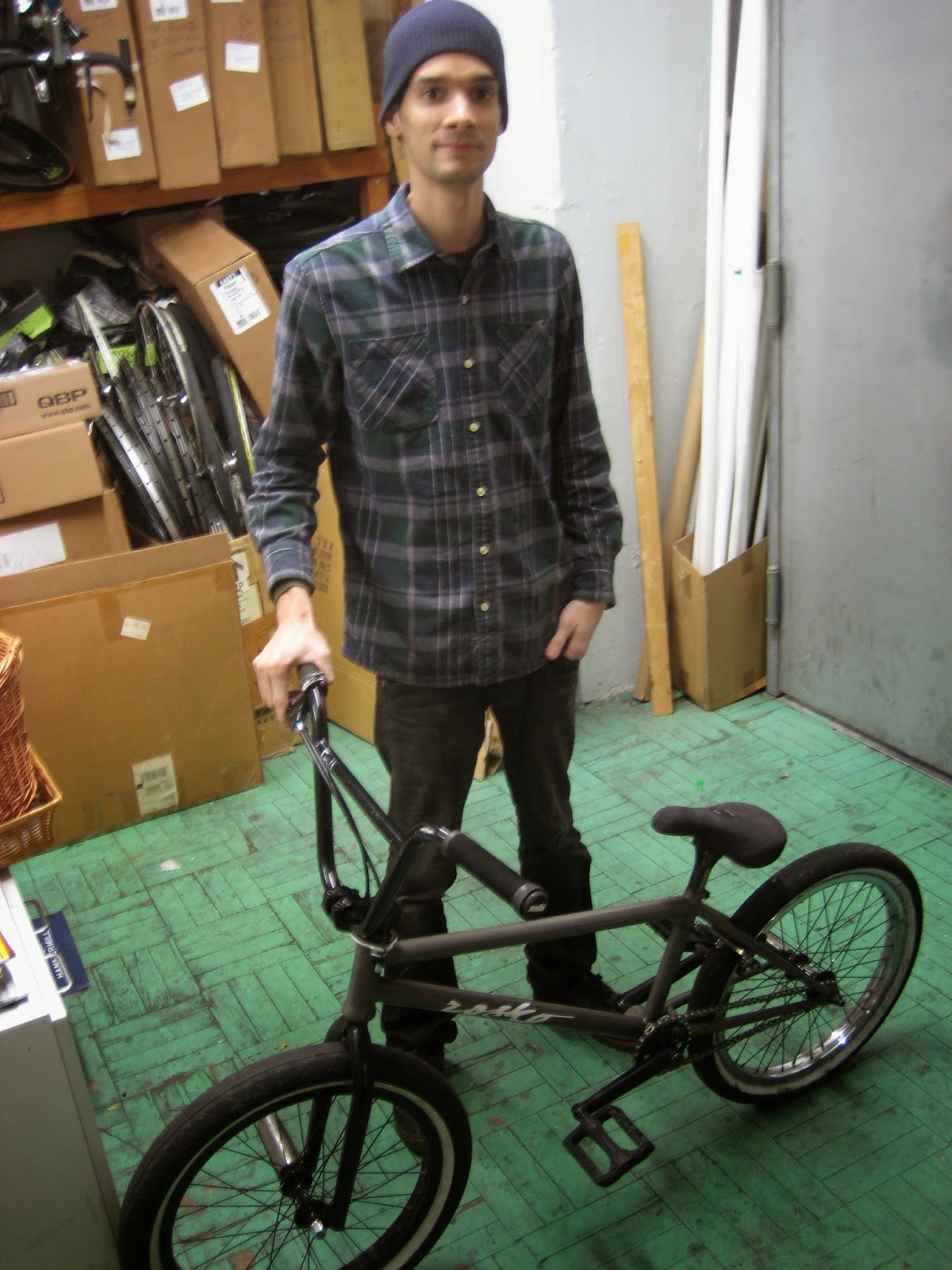
To Chris, who leads Recycle-A-Bicycle's volunteer night, "bicycling makes sense." Bicycles synthesize political and environmental concerns - the health benefits and lack of pollution make them ideal for knitting the gaps between subway stations and pedestrians and as alternatives to cars. Recycling bicycles takes a lot of skill and the folks at Recycle-A-Bicycle are experts on bike maintenance and repair. Yet Chris empathizes with those who aren't so mechanically inclined (like me!). The mission is to demystify the bike; make them less trendy and more normal. If more Brooklynites ride bikes we may better appreciate how economical and convenient they are rather than as fashionably functional recreational vehicles.
Subscribe to:
Posts (Atom)